

📢 Exciting news! All REDBO Premium Services now offer Buy Now Pay Later payment options, providing you with greater flexibility and convenience when listing your property! 👉 Get Now 👈
News & Insights
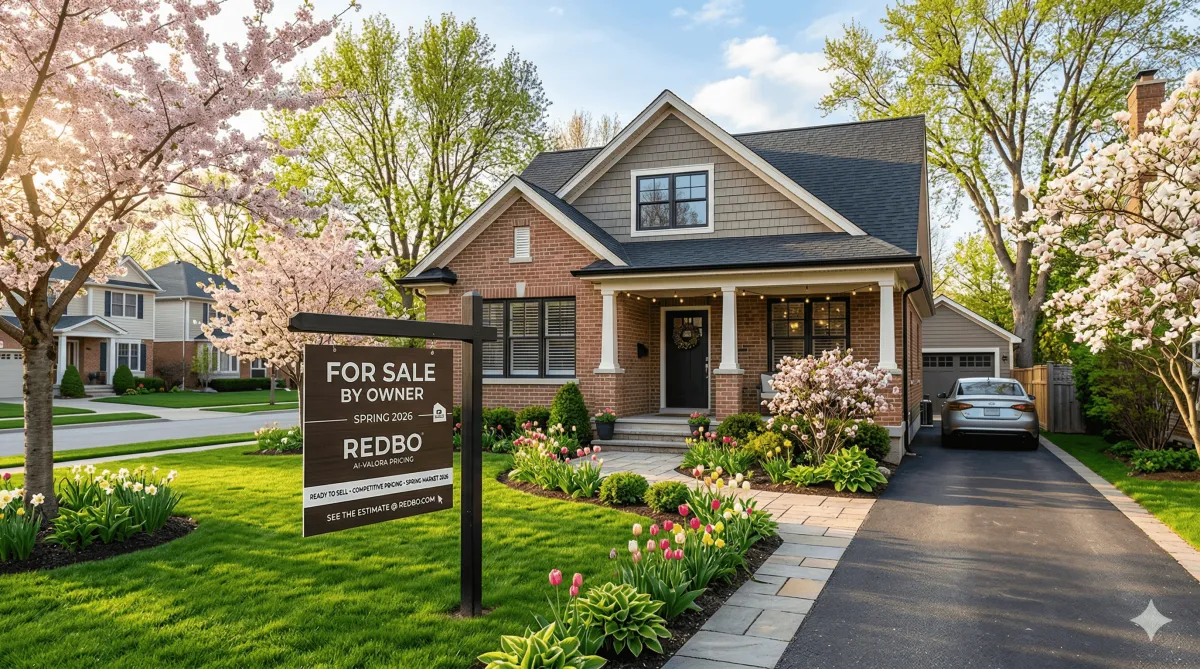
Spring 2026 Housing Market: Why Realistic Pricing Wins This Season
Spring 2026: The Return of Realistic Pricing
If 2024 was the year of sticker shock and 2025 was the year of wait and see, Spring 2026 is something different.
This is the year of the Realistic Pivot.
For the first time in nearly three years, homes are being listed at what they are actually worth. Not what the pandemic peak suggested. Not what an automated estimate showed last year. Not what the neighbor got in a bidding war 18 months ago.
If you are thinking about listing your home this spring — with or without an agent — this is the most important shift to understand before you pick a number.
What the market is telling us right now
Active listings are up 8.1% year over year. One in four homes listed in Q1 2026 saw a price reduction before finding a buyer. The median days on market hit 34 in February — a number that tells you buyers are not in a hurry.
The average 30-year fixed rate is sitting around 6.38%. That is not a crisis level. But it is a number that makes buyers careful and selective. They have more homes to choose from. They are doing the math before they schedule a showing.
Here is the behavioral shift behind those numbers.
When a home is priced too high, buyers are not making lowball offers. They are scrolling past it. No showing request. No inquiry. The listing sits. Days on market climb. And once a home crosses 30 days without an offer, buyers start wondering what is wrong with it — even when the only problem was the price.
The end of aspirationally priced listings
In 2025, plenty of sellers were still trying to catch the tail end of the bidding war era. They listed high, planned to negotiate down, and expected the market to reward their optimism. What happened instead was 45-plus days on market, two price reductions, and a final sale price below what a realistic day-one number would have delivered.
This spring, the sellers moving homes in under 30 days are the ones who came in priced for where the market is — not where it was.
Correctly priced listings are averaging around 22 days to contract. Homes that require multiple reductions are averaging 45 days or more. That gap is not just time. That is mortgage payments, carrying costs, and negotiating leverage you do not get back.
What realistic pricing actually means
Before you set a number, here is the math worth knowing.
A $20,000 overprice does not just mean a $20,000 reduction later. Here is how the real cost adds up.
Extra time on market typically runs 30 to 45 additional days. That adds roughly $2,500 to $4,000 in carrying costs alone. When the price cut comes, it usually has to be $15,000 to $25,000 to restart buyer momentum — because a stale listing loses energy fast. Then buyers negotiate below the new price, typically another $5,000 to $10,000 lower, because a listing that sat signals a seller who will accept less.
The real net cost of that original $20,000 overprice? Between $20,000 and $35,000, plus two extra months of your life.
Pricing right on day one is not leaving money on the table. It is keeping money in your pocket.
How to arrive at an honest number
Realistic pricing does not mean cheap. It means pricing based on what buyers are actually paying right now.
Start with homes that sold in the last 60 to 90 days, within a mile of yours, same size and similar condition. That is your real baseline — not last year's peaks and not automated estimates that have not caught up with the market yet.
Factor in the current direction. If prices in your area are flat or softening, build that into your starting point. Check what is actively listed right now. If there are 10 or 12 similar homes available in your area, buyers have real options. Price to stand out.
And ask yourself the hardest question: would you buy this home at this price if you were the buyer today? Your honest answer is the most reliable pricing signal you have.
The FSBO pricing advantage most sellers overlook
Here is something that rarely gets talked about.
When you sell without an agent, you are not paying 5% to 6% in commission. That savings gives you more pricing flexibility than a traditionally listed home — and you still net more at closing.
A FSBO seller who prices realistically is often in a stronger position than a comparable agent-listed home at the same sale price. Buyers know there is no commission layer in the middle. They show up more motivated. They come in with cleaner offers. The negotiation is simpler because both sides see the math clearly.
Price it right. That edge belongs to you.
Three questions to test your price before you list
Run your price through these before you go live.
Would you buy this home at this price if you were the buyer today?
Do the comparable sales from the last 60 to 90 days actually support this number — or are you reaching past them?
If this home sits for 60 days, will you drop the price anyway? If the honest answer is yes, skip the wait and start there.
Price it right. List it clean. Sell it smart.
The buyers are out there. Spring is still the most active season in real estate. Families are relocating. Rate-watchers who have been sitting on the sidelines for two years are finally ready to move.
But they are not desperate. They have choices. They will scroll past a home that feels overpriced without a second thought.
Sellers who come in with a fair, honest price get attention. They get showings. They close without the drama of a 90-day listing and three rounds of reductions.
That is what spring 2026 is asking for.
Ready to find your realistic starting price?
Run your address through AI Valora at REDBO.com. In about 60 seconds, you will see what comparable homes in your area are actually selling for right now — not what an algorithm guessed six months ago.
It is not a magic number. It is an honest starting point for a smart conversation about price.


Technology has made it easier for home buyers to find homes, but sellers are lagging behind. Still paying realtor commissions for what is now less complicated and easier job. You don't have to, and that's why so many sellers are finally changing the way they think about their home sale. Social media and technology has transformed this outdated process by allowing them to share and exchange their home sale information all by themselves. You can do it too.

Moving with children is not the ideal situation. Most parents and children see the stressful movement. However, what do you do when you manage to find your dream job in New York or another city in the country? Often you have no choice but to pack your house and move. But how do you make the moving process easier? There are some great moving tips to help the process go better. Of course, it is easier to move with grown children, while with younger children it is often an adventure in itself.

Technology has made it easier for home buyers to find homes, but sellers are lagging behind. Still paying realtor commissions for what is now less complicated and easier job. You don't have to, and that's why so many sellers are finally changing the way they think about their home sale. Social media and technology has transformed this outdated process by allowing them to share and exchange their home sale information all by themselves. You can do it too.

Moving with children is not the ideal situation. Most parents and children see the stressful movement. However, what do you do when you manage to find your dream job in New York or another city in the country? Often you have no choice but to pack your house and move. But how do you make the moving process easier? There are some great moving tips to help the process go better. Of course, it is easier to move with grown children, while with younger children it is often an adventure in itself.

How to Sell your House FSBO 2021
7 Keys of Success when it comes to FSBO. FSBO is getting more and more popular every single year. - Will save you a ton of commissions. Ready for the market I know this sounds obvious but you’d be surprised at how many people just put a sign in their front yard that says FSBO or posted on the website calm and prays for the best number. Comparable Properties You need to find at least 2-3 to 6 comparable properties to yours.




Follow us on Social Media:
(833) 697-3326