


Why Owning a Home Feels More Expensive Than Ever (Even When Rates Are Not Rising)
The Story Everyone Feels — But Few Fully Understand
There is a quiet frustration building across the 2026 housing market. Buyers are waiting. Sellers are hesitating. And homeowners — even those who locked in a good rate — are wondering: "Why does this still feel so expensive?"
Mortgage rates have stabilized in the high 5% range. The panic of rapid increases has cooled. Yet affordability has not improved.
The problem is not the mortgage. It is something deeper.
The short version: Rates are no longer the main affordability problem. Non-debt costs — insurance, taxes, maintenance — now drive the monthly budget. These increases are not temporary. Waiting for rates to drop alone will not fix this.
Welcome to the Expense Lock Era
Most people have heard of "Rate Lock" — homeowners holding on to their 3% mortgages and refusing to move. That era shaped the last two years of housing.
What is happening now is different. Call it the Expense Lock.
We have moved from a debt problem to a carrying cost problem. Here is what the average homeowner's dollar looks like today versus just a few years ago:
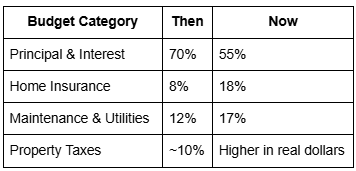
The mortgage payment shrunk as a share of the budget — not because it got cheaper, but because everything else got more expensive around it.
Stop evaluating a deal based on the mortgage payment alone. The question to ask is: What does this home cost to own every month, total?
The Three Silent Budget Killers
1. Insurance: The New Deal Breaker
Insurance used to be a line item in escrow that most people ignored. Not anymore.
Premiums are up 30% to 100% or more in many markets. Standard policies that cost $1,200 a year a few years ago are now running $3,000 or higher. In some regions, major carriers have pulled out entirely — leaving fewer options and steeper prices.
Practical warning: Many buyers discover the real insurance cost after going under contract. That surprise can break the debt to income ratio and kill the deal. Get insurance quotes before you make an offer — not after.
2. Property Taxes: The Lagging Shock
Taxes are catching up to the price spikes of 2021 and 2022. Many markets have seen assessments jump 20% to 40% based on those peak values.
New buyers often inherit those inflated assessments. Standard online calculators do not show this. You may close on a home and see your tax bill spike a year later.
What to check: Find out when the property was last assessed and whether a sale triggers a new one. In many counties, it does.
3. Maintenance: The Cost Nobody Budgets
Maintenance is not an occasional surprise. It is a predictable, monthly expense that most buyers treat as optional until something breaks.
The standard rule: budget 1% to 2% of the home's value every year. On a $350,000 home, that is $300 to $600 per month. If you stretched to win a bid on a property with deferred repairs, that number can be much higher in year one.
The Strategy: How to Win in 2026
For Buyers
A 5.5% loan on a high carrying cost home can cost more per month than a 6.2% loan on a clean property. The rate is not the whole story.
Before you make an offer: get the insurance quote, review the tax assessment history, and build maintenance into your budget from day one. These three steps take a few hours and can save you thousands in surprises.
For Sellers
Today's buyers are payment focused and risk aware. They are looking for reasons to hesitate. You win by removing the mystery.
Provide documented insurance estimates. Be upfront about taxes. Address deferred maintenance before listing — or price it in clearly. Transparency moves deals.
One more thing sellers should know: You cannot control interest rates, but you can control how much equity you keep. Paying $20,000 or more in traditional commissions is one of the largest costs in a transaction — and it is avoidable. Flat fee models like REDBO let you keep that equity and put it toward your next move.
The Bottom Line
The right question to ask is not "What is the rate?"
It is "What does this home actually cost to own?"
Affordability is no longer just a rate problem. Insurance, taxes, and maintenance have become structural costs that are not going away. The buyers and sellers who succeed in 2026 are the ones who look at the full financial picture — not just the monthly payment on the listing page.
Clarity beats timing. Strategy beats speculation. Awareness protects your equity.
Michael Vrlaku | Branch Manager, New American Funding | NMLS #179115 Data Source: REDBO.com Mortgage Audit Data — March 2026